

Cost of working materials
It is the employer's duty to bear the costs of instruments, tools, supplies, and personal protective equipment used at work.

The Costs Involved in the Work
The roles played by workers and entrepreneurs in the development of an economic activity are very different.
Workers depend exclusively on their wages to survive and, just as they do not receive the profits made by the company and do not decide on its investments, they should not be held responsible for the economic risks involved in a business.
The costs of performing an economic activity must be borne by companies and cannot be transferred to workers, thereby impacting their remuneration.
Therefore, companies must guarantee workers the conditions for the safe performance of their activities, including the free provision of Personal Protective Equipment.
Platforms and Labor Costs
The business models of various digital platforms transfer the costs of tools, instruments, and inputs necessary for the performance of a given economic activity to the workers themselves.
In such cases, platforms largely exempt themselves from expenses related to the acquisition, administration, maintenance, depreciation, interest, etc. of work-related assets. This becomes particularly problematic because:
- Despite bearing the cost of work tools, workers are unable to include these expenses in the prices of their services, since it is the platforms themselves that set these prices.
- Consequently, the increase in the prices of inputs and work materials may have a stronger impact on the remuneration of these workers;
- Expenses for supplies and equipment when workers are available to the platforms but are not performing a service are not remunerated (drivers driving without passengers, for example).
- Workers do not have the same resources as companies to
absorb the costs of inputs and work tools. both in terms or professionals
specialized in analyzing and managing these costs and in terms or the abity to make large-scale purchases, which reduces the prices of work tools and
inputs.
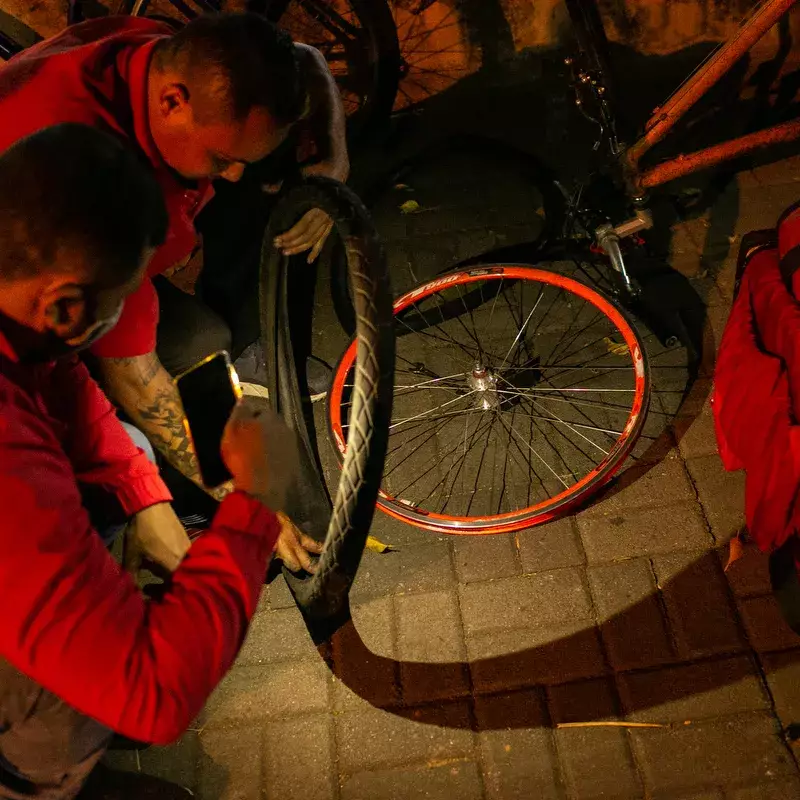
“The plaintiff only had a motorcycle and a cell phone. These are accessory or complementary means. The essential infrastructure for carrying out this activity is the software developed by [delivery platform], which connects commercial establishments with end customers. The platform in question is an essential element for the provision of the service. The plaintiff did not have significant infrastructure of his own that would allow him to operate on his own.”
Tribunal Supremo Espanhol – Decisão sobre Plataforma de Entregas
Labor Costs and Incorrect Classification of Workers by Platforms
Within the business model of many digital platforms, workers' ownership of work instruments and tools and their responsibility for input costs can often be used as arguments that they are "self-employed workers." This is because they are supposedly "owners" of the means of production, which they themselves acquire and manage, which would characterize them as microentrepreneurs rather than workers.
This argument is contested by several studies showing that, in the business models of various platforms, the basic means of production is the platform itself —as the main instrument for managing and controlling the workforce—and not the vehicles and tools used, for example, by drivers and delivery personnel. Not surprisingly, European courts, when deciding on the classification of workers, have considered the use of cars, bicycles, motorcycles, telephones, and personal computers to be secondary, while pointing to the central role of control and direction exercised by digital platforms.
In addition, some digital platforms seek to increase their profits by selling work tools, which are often customized with the companies' brands, associating workers with them. Companies sell backpacks, uniforms, personal protective equipment, but also cell phone plans, credit cards, car rentals, bicycles, and motorcycles, etc. Many other platforms also use their customized products to reward the most diligent workers and often promote free distribution of these items, as in the case of delivery workers' backpacks.
Thus, directed, controlled, and associated with the brands of the platforms, workers do not engage in genuine business activity, but are nevertheless mistakenly classified as self-employed.
By absorbing the costs of economic activity without being able to effectively decide on business management, workers, in the worst cases, not only have their remuneration affected but may also incur debt.
SOURCES
Marco Gonsales - De Mochila nas Costas: uma Experiência Etnográfica como Entregador por Aplicativo. Em Ricardo Antunes - Icebergs à Deriva: o Trabalho nas Plataformas Digitais, Editora Boitempo, 2023.
Vitor Filgueiras e Ricardo Antunes. Plataformas Digitais, Uberização do Trabalho e Regulação no Capitalismo Contemporâneo. Em Ricardo Antunes – Uberização, Trabalho Digital e Indústria 4.0, Editora Boitempo, 2020.