

Working on platforms
In 2022, according to data from the Brazilian Institute of Geography and Statistics (IBGE), there were approximately 1.5 million people working on digital platforms/apps in Brazil.
What is Digital Platform Work?
Work via digital platforms has become well known in several countries through the activities of millions of drivers and delivery personnel, organized by what is known as algorithmic work management.
An algorithm is a set of predetermined instructions for solving a problem. It is a mathematical resource that has been used for many centuries. However, with the technological developments of recent decades, the ability to capture and process data has increased its power and scope, leading to its application through digital devices in a variety of situations.
In the case of algorithmic work management, such technological developments are used for largely automated decision-making involving various stages of economic activity: creating worker profiles, distributing tasks, setting prices, directing and controlling work, evaluating results, imposing penalties, etc.
Although they have become popular ride-hailing apps, digital platforms and so-called algorithmic work management are not restricted to these sectors.
These forms of work organization have been implemented in a wide range of activities, whether carried out in the physical world or entirely online: from product delivery and home cleaning to website development and artificial intelligence training.
What Challenges Has Platformization Brought to the World of Work?
The introduction and spread of digital platforms and algorithmic management have brought a set of challenges to workers and public authorities around the world.
Firstly, there is the issue of worker classification.
The absence of a human figure managing the work and the possibility of turning an application on and off may make it seem that the work performed on different digital platforms is autonomous.
However, as courts in several countries have pointed out, many digital platforms command, direct, control, monitor, evaluate, and punish their workforce.
This means that, in these cases, platforms must respect a set of historically acquired rights, just as other employers do.
However, workers are often incorrectly classified as self-employed, even though they do not actually have autonomy. Thus, on the one hand, they do not have the possibility of genuinely entrepreneurial activity and, on the other, their rights as employees are not respected.
The result is work insecurity, which can affect your remuneration, as well as your working hours, your health, relationships with family members, and impact on society as a whole—especially considering the possibility of platforms spreading to various professions.
In addition, largely automated methods of managing the workforce have raised questions about transparency and the performance of algorithmic management.
It is unclear to both workers and consumers how and when their data is captured and how it is used by platforms. Furthermore, the implementation of algorithmic management make it necessary to protect workers from arbitrary decisions made in automated ways.
What Are the Possible Impacts of the Platformization of Work in Brazil?
Several studies indicate that in the best-known sectors of delivery and private passenger transport, the process of platformization of work is marked by control and precarization.
Drivers and delivery workers, for example, point to the way in which essential aspects of their work are determined by the platforms, such as the setting of service prices, customer choices, and deadlines for completing activities.
Research shows, on the other hand, that the platformization of work has impacted workers' pay and working hours. Drivers and delivery workers on platforms, for example, work longer hours and earn significantly less than those who are not platformized.
Furthermore, workers on many digital platforms are excluded from a range of rights that guarantee decent working conditions, health and safety, and a future backed by social security.
How many workers work on platforms/applications in Brazil?
How many workers work on platforms/applications in Brazil?
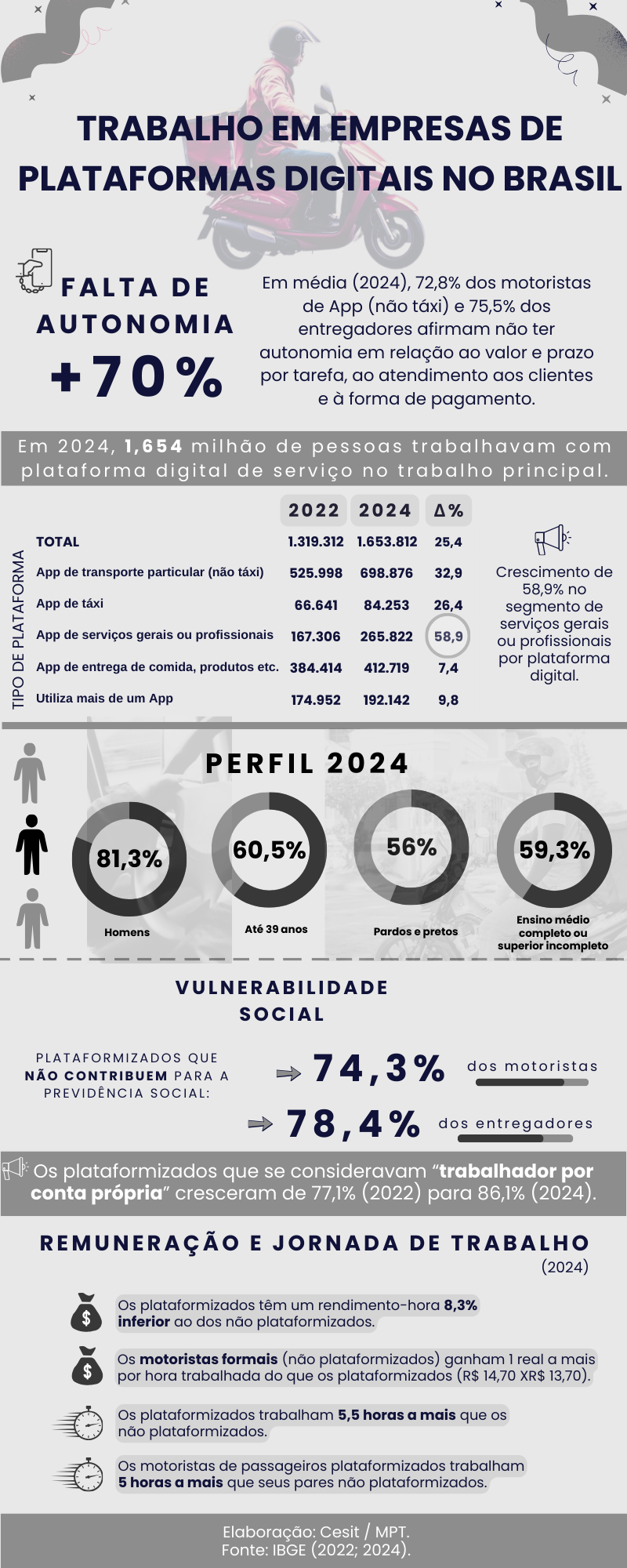
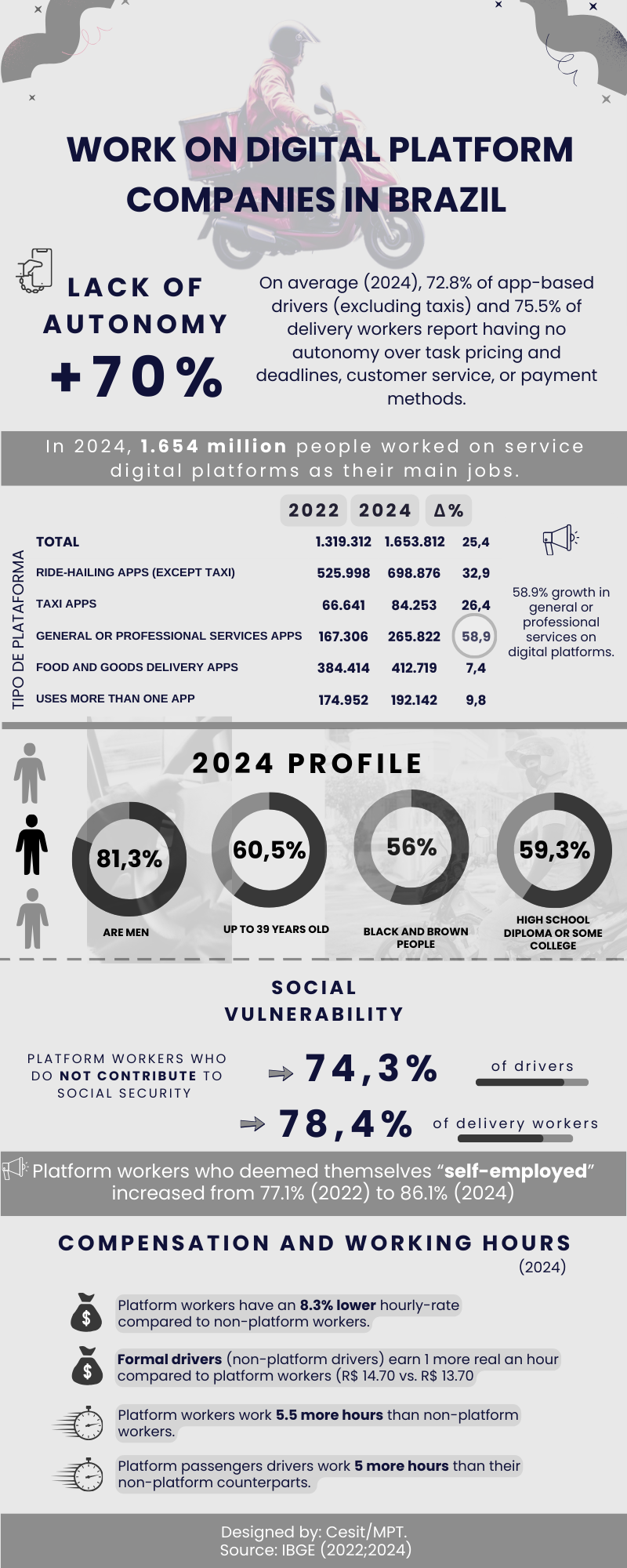
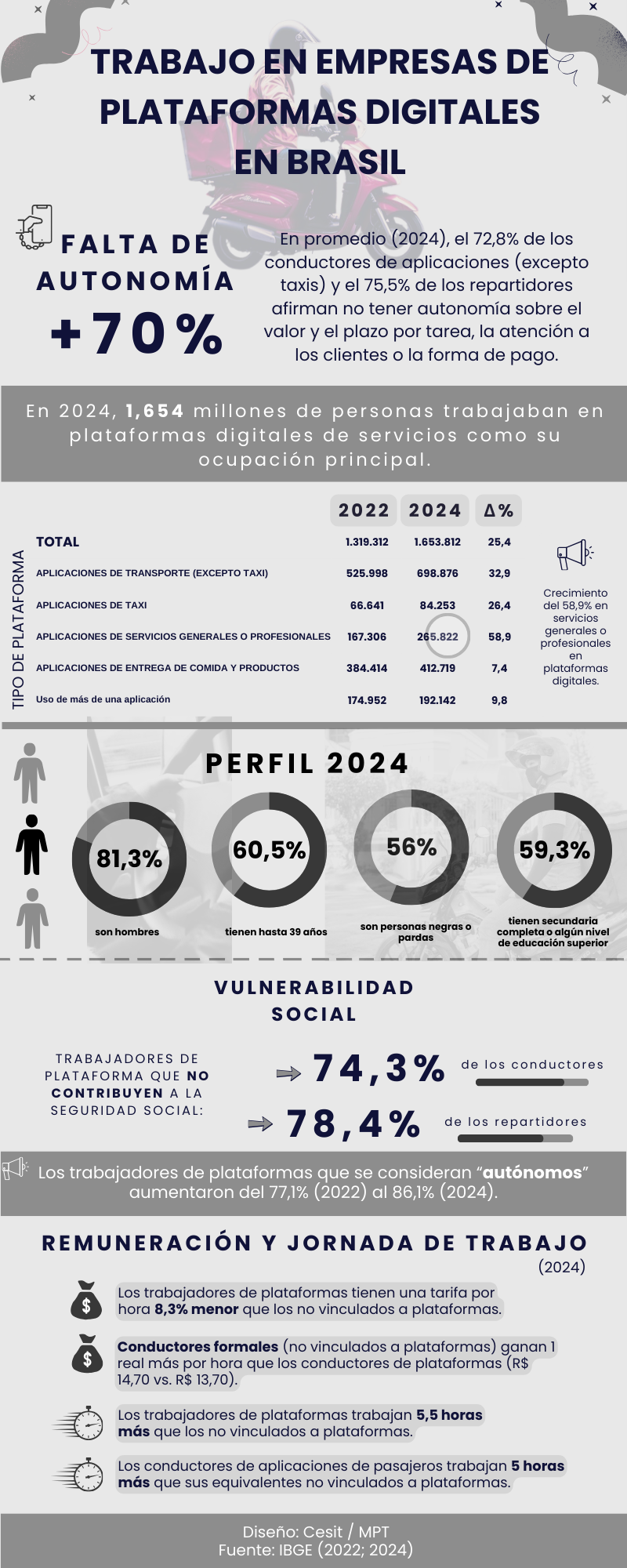
According to data from the Brazilian Institute of Geography and Statistics (IBGE) for 2022, there were approximately 1.5 million workers on digital platforms in Brazil. Of this total, around 778,000 workers had ride-hailing apps as their. This corresponded to 52.2% of the total number of workers on platforms/apps.
In turn, 589,000 were delivery app workers, accounting for 39.5% of the total, and in service provision apps, there were approximately 197,000, accounting for 13.2%.
What is the profile of workers on platforms/apps in Brazil?
Also according to IBGE data, in 2022, the profile of workers on digital platforms was mainly:
81,3%
Male
61,3%
High school diploma or incomplete higher education
48,4%
Aged between 25 and 39